
Industrial Automation and Robotics
PROGRAM LENGTH:
50 WEEKS | 1000 HOURS
THEORY | LAB | CAPSTONE
Program Overview
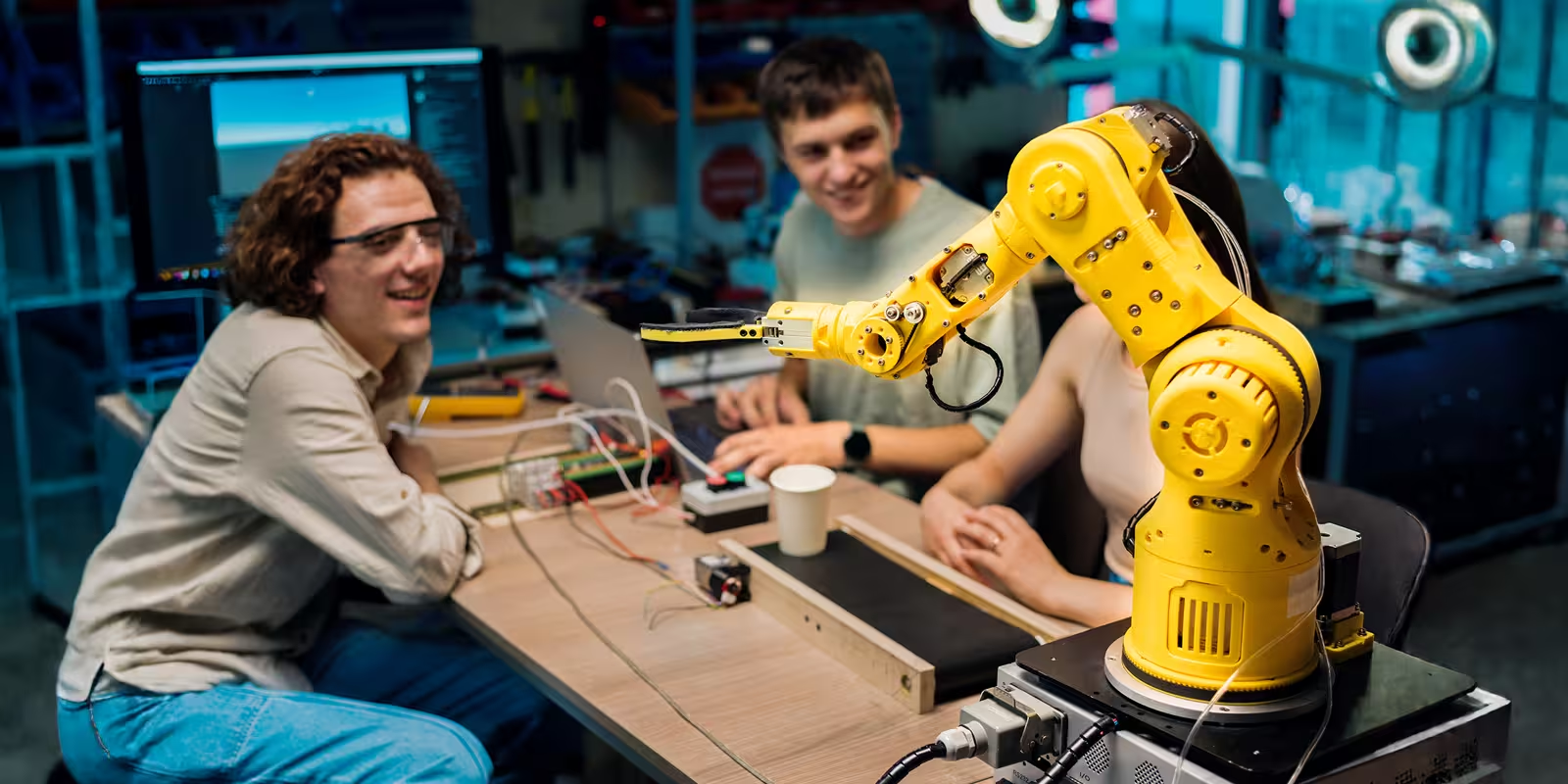
The Industrial Automation and Robotics Diploma Program at Oxford College prepares students for careers in the dynamic world of automated manufacturing, smart systems, and industrial robotics. Designed to meet the needs of modern industry, this 1000-hour program blends foundational electrical theory, hands-on programming, and applied robotics with advanced topics such as machine vision, control systems, and Supervisory Control and Data Acquisition (SCADA) integration. Students gain practical experience with programmable logic controllers (PLCs), mechatronics, industrial sensors, and automation networks. They will learn to troubleshoot and maintain automated systems while developing a deep understanding of electromechanical systems and process control. Graduates are well-equipped to support the design, installation, and optimization of automated manufacturing environments. Students in this program are prepared for the following certification examination:
- Robotic Process Automation (RPA) certification
Certifications from recognized bodies (e.g., ISA, Siemens, Rockwell) and continued skills development in PLC programming, SCADA configuration, and machine vision technologies can further enhance employment.
Course Descriptions
Module Name
Fundamentals of Electrical and Electronic Systems
Programmable Logic Controllers (PLCs) and Industrial Control
Sensors, Instrumentation, and Process Control
Robotics Fundamentals and Kinematics
Industrial Networking and Communication Protocols
Mechatronics and Electromechanical Systems
Control Systems and Automation Theory
Human-Machine Interfaces (HMI) and SCADA Systems
Introduction to Machine Vision and Smart Sensors
Capstone Project in Industrial Automation
Total
Module Hours
100
100
100
100
100
100
100
100
100
100
1000
Areas of Focus
- Electrical, electronic, and control system fundamentals
- Programming and integration of PLCs
- Instrumentation, sensors, and process control
- Robotic arms, kinematics, and motion control
- Industrial networking and real-time communication
- Mechatronics and integrated electromechanical systems
- Human Machine Interface (HMI)/SCADA development and monitoring
- Machine vision and smart sensor technology
- Control theory and automation system design
- Capstone project applying practical automation skills
Job Profile
Graduates of the program are prepared for careers in industrial automation, robotics integration, process control, and manufacturing support. They may work as automation technicians, control systems specialists, robotics operators, robotic programming and PLC programming or electromechanical technicians. These professionals are valued for their ability to install, maintain, troubleshoot, and optimize automated equipment and robotic systems in a variety of industries.
Potential Employers


Course Topics
Fundamentals of Electrical and Electronic Systems
This course introduces students to foundational electrical and electronic concepts essential to automation. Topics include basic electrical theory, Ohm’s Law, AC/DC systems, wiring schematics, and circuit analysis. Students gain practical experience using multimeters, assembling circuits, interpreting electrical drawings, and troubleshooting common electrical faults in industrial settings. Emphasis is placed on electrical safety, component identification, and compliance with industrial standards. By the end of the course, students will be able to diagnose issues, replace faulty components, and ensure operational safety in automated environments.
Programmable Logic Controllers (PLCs) and Industrial Control
Students gain in-depth knowledge of PLCs, focusing on hardware configuration, ladder logic programming, and real-time simulation. They develop control sequences for conveyors, robotic arms, and industrial processes using I/O modules and function blocks. The course also explores advanced topics such as timers, counters, and analog inputs/outputs. Troubleshooting, code documentation, and integration with SCADA/HMI systems are emphasized. Students work with industry simulation software to test and deploy their PLC logic in practical lab settings.
Sensors, Instrumentation, and Process Control
This course explores a wide variety of industrial sensors and instrumentation used in modern process control systems. Students work with proximity and photoelectric sensors, flow meters, thermocouples, and pressure transducers. They calibrate and interpret sensor outputs and design feedback systems using PID controllers. Analog and digital signal conditioning, noise reduction, and real-time monitoring strategies are also discussed. Lab sessions focus on integrating sensors with PLCs and optimizing control loops for industrial scenarios.
Robotics Fundamentals and Kinematics
Students are introduced to robotic automation through coordinate geometry, motion planning, and robotic programming. Robot types including articulated, SCARA, and Cartesian models are analyzed for real-world suitability. Kinematic equations, velocity mapping, and path planning techniques are explored through both theory and hands-on simulations. Emphasis is placed on robotic safety, task optimization, and deployment within industrial cells. Projects involve designing robotic workflows and troubleshooting task inefficiencies in simulated environments.
Industrial Networking and Communication Protocols
This course examines the communication systems that enable automation devices to exchange data. Students learn to implement protocols like Ethernet/IP, Modbus, Profibus, and CANbus across various topologies. The course covers network addressing, latency reduction, bandwidth optimization, and diagnostic tools. Through labs, students design network architectures that connect PLCs, HMIs, and SCADA systems while ensuring secure and efficient data transmission. Emphasis is placed on practical troubleshooting and device configuration.
Mechatronics and Electromechanical Systems
Students explore the integration of mechanical, electrical, and software elements in automation. They study actuators, gear trains, servo and stepper motors, solenoids, and power transmission systems. Through hands-on lab work, they construct and troubleshoot mechatronic systems, interpret technical diagrams, and understand the physical dynamics of machines. Emphasis is placed on energy conversion, feedback systems, and synchronization of components in automated manufacturing processes.
Control Systems and Automation Theory
This course covers control engineering principles including feedback loops, system response, stability, and mathematical modeling. Students use simulation tools to model real-world automation scenarios, including transfer functions and root locus analysis. Topics include PID tuning, logic control, and feedforward strategies. Learners evaluate system performance under variable conditions and apply optimization techniques to enhance accuracy and stability in automation systems.
Human-Machine Interfaces (HMI) and SCADA Systems
Students develop interactive HMI screens and configure SCADA systems for real-time process monitoring. The course covers alarm handling, trend visualization, event logging, and remote access setup. Students work with industry-standard SCADA software to simulate complex process industries such as water treatment and manufacturing. System security, operator usability, and integration with PLCs and sensor networks are key areas of focus.
Introduction to Machine Vision and Smart Sensors
This course introduces students to the principles of industrial vision systems and smart sensors. They learn about lighting setups, lens selection, object recognition, and integration of vision systems into automation workflows. Use cases such as barcode scanning, defect detection, and robot guidance are explored. Students also program smart sensors with embedded intelligence for adaptive process control and efficiency gains.
Capstone Project in Industrial Automation
In this culminating project, students work independently or in teams to design and implement a comprehensive industrial automation solution. Drawing on skills from throughout the program, they create systems involving PLCs, SCADA, robotics, and sensors. Students document system design, code, testing, and evaluation procedures. Projects are presented to instructors and peers, demonstrating the student’s ability to manage automation projects from conception to execution while meeting safety, quality, and efficiency standards.
Why Choose Oxford College?
Career-Focused Education
All of the diploma programs are designed for long-term careers in high-growth industries, offering you a superior fast-track education.
Expert Instructors
Our faculty consists of experienced and well-trained staff, who will give you industry-relevant knowledge along with your career training.
Modern Facilities
The state-of-the-art classrooms and labs are compliant with industry standards and allow for an emphasis on practical training.
Easy Campus Access
All our six campuses are located along transit hubs making travel easy and conveniences accessible.
Flexible Start Dates
Flexible program start dates allow you to plan and begin your new career training at any time.
Financial Aid
Financial Aid may be available to those who qualify. We have dedicated staff who can assist you with the Financial Aid process.
Employment Outlook
The demand for skilled professionals in automation and robotics in Ontario is growing as industries move toward smart manufacturing. Robust growth during 2025-2026 period is also driven by the need for increased productivity in manufacturing, the rise of electric vehicles and an aging workforce. The demand for specialized skills in automation, PLC programming and robotics maintenance remains high.
Major growth drivers include:
- Increased automation in manufacturing and logistics
- National investments in advanced manufacturing and clean technology
- Greater reliance on robotics and process optimization in industrial sectors
- Rising demand for real-time data integration and predictive maintenance systems
- Rising demand for electric vehicle (EV) production
Admission Requirements
OSSD or Equivalent
OR
Mature Student Status with Wonderlic SLE – 17
Delivery Format
This program is available in four delivery format options: in-person, hybrid, online, or asynchronous. Students may participate in scheduled instructor-led classes or complete the program through self-paced online modules, offering flexibility for different learning styles and schedules.
★ ★ ★ ★ ★
Joining Oxford College was one of the greatest decisions I have made and I feel so fortunate to be one of your students. I’m really enjoying your virtual classes, you are an amazing and inspiring mentor. The style and method of your teaching tells me that I’m on the right track towards my potential career.
Personalized, Lifelong Career Counselling Services

At Oxford College, our support does not end after you graduate. Even after you earn your Diploma, our Career Service Advisors will continue working with you and help you build your career path together, for the long term.
Financial Aid
Many people need extra financial aid to attend school. At Oxford College, we believe that finances should not be a barrier for anyone seeking higher education. That’s why we have many funding programs in place, including OSAP, Second Career, and private student loans, to name a few. We will also collaborate with you to set up manageable monthly payment plans.
Sit down with a Financial Aid Advisor today. They will assess your situation.
And create a funding plan that works for you.
Get More Info…
If you’re interested in learning more about Oxford College and exploring if this is the right career path for you, fill out the form on this page to receive more information.
For immediate questions, call 1-866-604-5739