
Become an Intra-Oral Dental Assistant in 50 Weeks
Oxford College’s Intra-Oral Dental Assisting Level I and II Post-Graduate Diploma prepares you for hands-on clinical work in Ontario dental offices. When you graduate, you are eligible to write the National Dental Assisting Examining Board (NDAEB) exam, with no Clinical Practice Evaluation (CPE) required.
This program is built for newcomers with dental or health training from abroad, career changers, and recent graduates who want a direct route into patient care.
50 Weeks | NDAEB Exam Eligible · In-Person Clinical Training · Morning, Afternoon, or Evening Classes
Who This Program Is For
Students come to this program from very different starting points. Most fall into one of three situations, and the program is designed to work for each.
You trained in dentistry or health care outside Canada.
You already know what it means to work with patients, but your credential may not let you practice here. This program gives you a Canadian Post-Graduate Diploma and prepares you to write the NDAEB exam, so you can return to clinical work in 50 weeks instead of starting over from the beginning. You will also study alongside classmates from more than 200 nationalities across Oxford College’s student body.
You are ready to leave retail, office, or administrative work.
You want a job with more purpose and a clear skill set, and you do not have years to spend in school. This program requires no previous health care experience. Because you can choose a morning, afternoon, or evening schedule, you can plan your training around your current job or family responsibilities.
You recently finished high school or college.
You may be deciding between a four-year degree and a faster route into a health career. This program takes 50 weeks, and with intakes in January, May, and September, you do not have to wait long to begin. When you finish, you will earn a diploma and receive hands-on clinical training that prepares you for work in a dental office.
This program may not be right for you if you want to study entirely online.
Intra-oral dental assisting is hands-on work. You will work in a clinical setting, close to patients, and you will handle saliva, blood, and other bodily fluids as part of routine care. You cannot complete the program online. Clinical hours, radiology labs, and the 80-hour field placement all take place in person.
50
Weeks
to a Post-Graduate Diploma
3
Intakes a year
with morning, afternoon, and evening schedules
6
Ontario campuses
Toronto, Scarborough, Mississauga, Burlington, Barrie, and Peterborough
$54,080
Ontario median wage
for dental assistants (Job Bank Canada, NOC 33100, updated November 19, 2025)
What an Intra-Oral Dental Assistant Does
What Does an Intra-Oral Dental Assistant Do?
An intra-oral dental assistant works chairside with dentists and dental hygienists. You help patients feel comfortable, keep the treatment room safe and ready, and carry out specific procedures in the patient’s mouth under a dentist’s direction. The “Level I and II” in the program name refers to these two layers of the job.
Level I: Supporting the dental team at the chair
Level I duties are the foundation of every dental assistant’s day. You greet and seat patients, prepare the treatment room, and set out the instruments the dentist will need. During a procedure, you pass instruments, manage suction, and keep the work area clear. Between patients, you clean and sterilize equipment and follow infection-control steps so every patient is treated in a safe environment.
Level II: Working in the patient’s mouth
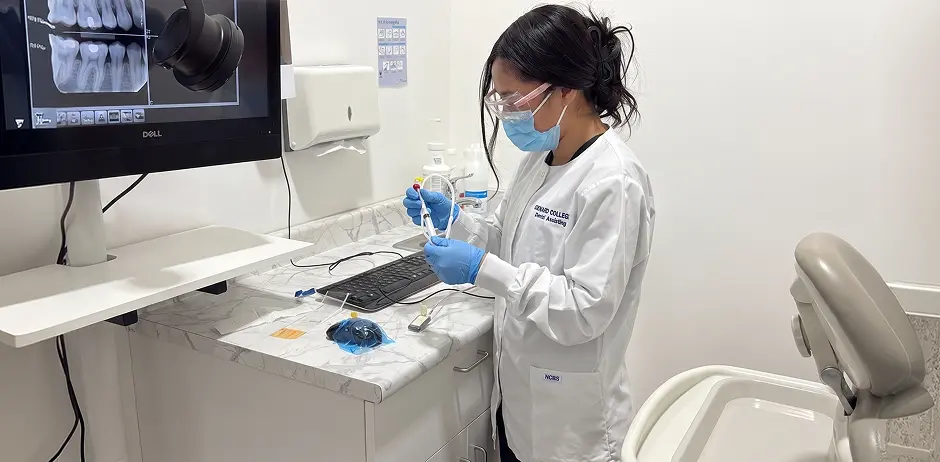
Level II adds hands-on intra-oral skills. Depending on the dentist’s direction, you may polish teeth, apply fluoride and sealants, place and remove dental dams, and take preliminary impressions. Because the program includes Radiology I and II, you also learn to take dental X-rays.
What a typical day looks like
A morning might start with preparing the room for a cleaning, then taking X-rays for a new patient before the dentist’s exam. Later in the day, you might assist with a filling, apply sealants for a child, and explain brushing and flossing techniques to a patient before they leave. Throughout the day, you keep records up to date and reset the room for each new appointment.
Where you could work
Graduates prepare for roles such as:
- Intra-Oral Dental Assistant
- Dental Office Assistant
- Preventive Dental Assistant
- Dental Receptionist
These roles exist in dental offices, community health centers, educational institutions, and clinics.
The Credential and the Exam
Your Diploma and the NDAEB Exam
When you complete this program, you earn a Post-Graduate Diploma in Intra-Oral Dental Assisting Level I and II. You also become eligible to write the NDAEB exam, which is the next step toward national certification as a dental assistant.
What is the NDAEB exam?
The National Dental Assisting Examining Board (NDAEB) administers a national exam that tests the knowledge a dental assistant needs to work safely and competently in Canada. Passing it shows employers that you meet a national standard for the profession, not only the requirements of one school.
Why “no CPE required” matters
Some dental assisting candidates must complete a Clinical Practice Evaluation (CPE) in addition to the written exam. The CPE is a separate hands-on assessment that adds time, cost, and another step before certification. Graduates of this program are eligible to write the NDAEB exam with no CPE requirement, so you can move from graduation to the written exam without that extra stage.
Radiology training is built in
Taking dental X-rays is a core part of intra-oral work, and Ontario regulates it. The program includes Radiology I and II, and the curriculum is aligned with Ontario’s Healing Arts Radiation Protection (HARP) Act, which sets the rules for safe use of X-ray equipment. You practice these skills in in-person radiology labs before you work with patients.
27 Courses That Take You From Basics to the Dental Chair
Every one of the 27 courses in this program builds a skill you will use in a dental office.
You take them one at a time, in five stages, and each stage prepares you for the next.
- Health Care Foundations
You learn how the body works, the medical terms the dental team uses, how to write clear patient records, and how health care laws and ethics apply to your work.
| COURSE | COURSE CODE |
| Medical Terminology | HSMT 106 |
| Introduction to Anatomy and Physiology | HSAP 106 |
| Introduction to the Health Care Workplace | HSHC 106 |
| Introduction to Health Care Laws and Ethics | HSHE 106 |
| Documentation and Professional Writing | HSDW 106 |
| Practical Math | HSTM 106 |
- Safety and Infection Control
You learn to sterilize instruments, keep treatment areas clean, handle hazardous materials safely, and respond to a medical emergency.
| COURSE | COURSE CODE |
| Infection Prevention and Control | HSIC 106 |
| Workplace Hazardous Materials Information System (WHMIS) | GEWH 106 |
| Aseptic Procedures | DAAS 106 |
| First Aid and Cardiopulmonary Resuscitation (CPR) | GEFA 106 |
- Dental Science and Chairside Assisting
You learn to support the dentist during treatment, work with dental materials, understand the medications used in dental care, and deliver preventive care such as fluoride, sealants, and oral hygiene education.
| COURSE | COURSE CODE |
| Principles of Dental Assisting I | DAPP 106 |
| Principles of Dental Assisting 2 | HSPR 200 |
| Principles of Dental Assisting 3 | HSPR 300 |
| Dental Materials | DADM 106 |
| Operative Dentistry | DAOD 106 |
| Preventive Dentistry | DAPD 106 |
| Introduction to Pharmacology | DAPH 106 |
- Radiology and Clinical Practice
You learn to take dental X-rays in line with Ontario’s Healing Arts Radiation Protection (HARP) Act, and you perform chairside and intra-oral procedures in person, in supervised clinical labs.
| COURSE | COURSE CODE |
| Radiology I | DARD 106 |
| Radiology II | HSRD 200 |
| Principles I | DAPR 106 |
| Principles II | DAPR 206 |
| Principles III (Clinic A) | DAPR 306 |
| Principles III (Clinic B) | DAPR 406 |
- Career Skills and Field Placement
You build communication, financial, and job search skills, then complete an 80-hour field placement in a real dental setting. The placement is part of your training and counts toward your diploma. It is not a job offer.
| COURSE | COURSE CODE |
| Essential Skills I: Communication Skills | GEES 106 |
| Essential Skills II: Financial Skills | GEES 107 |
| Essential Skills III: Career Skills | GEES 108 |
| Dental Field Placement | FPDC 900 |
How the Program Fits Your Life
- Built Around Your Schedule and Your Commute
You have a job, a family, or other commitments, and your training needs to work around them. This program is designed with that in mind (from how long it takes to where and when you attend). - 50 weeks from start to diploma
The program takes 50 weeks to complete. You take one course at a time, which lets you focus on a single subject before moving to the next. This structure also keeps the program moving at a steady pace without long breaks between terms. - Three start dates each year
New classes begin in January, May, and September. If you decide to enroll, you will not have to wait long for the next intake to start. - Morning, afternoon, or evening classes
You can use this choice to keep working while you train, or to fit classes around childcare and family responsibilities. - Six campuses across Ontario
The program runs at Oxford College campuses in Toronto, Scarborough, Mississauga, Burlington, Barrie, and Peterborough. You can choose the campus that is closest to where you live or work. - What happens in person
This program is delivered in person, with some hybrid components. Your clinical hours, radiology labs, and 80-hour field placement all take place in person because you must practice these skills with real equipment and supervision. Some theory-based coursework is delivered in a hybrid format. You cannot complete the program online.
Your Instructors
The people who teach you shape how ready you feel on your first day in a clinic.

Cecilia Quinteros
Program Coordinator
Program Coordinator
Cecilia trained as a dental assistant before joining Oxford College as an instructor in this program.
She now leads the program as Program Coordinator, overseeing curriculum alignment with the NDAEB exam and the program’s preparation for future accreditation review.

Feugiat neque nisi interdum velit pharetra laoreet. Faucibus dis risus elementum imperdiet quis. Nibh elementum nunc non elit. Commodo sit at non nulla enim scelerisque augue. Semper scelerisque nunc accumsan eget elit morbi. Cras turpis aenean adipiscing nunc nunc interdum amet.
Instructor Name
Title
Credentials
Campus
Outcomes
When you graduate, you will be prepared to apply for four types of dental roles in Ontario. Each one uses the chairside, intra-oral, and patient care skills you learn in the program, and each one exists across several kinds of workplaces.
Wages and job outlook in Ontario
The median wage for dental assistants in Ontario is $54,080 per year, or $26.00 per hour, according to Job Bank Canada (NOC 33100, Dental Assistants, updated November 19, 2025). Job Bank rates the employment outlook for dental assistants in Ontario as “Good” for 2025 to 2027.
Growing demand for dental care
More Ontarians now have dental coverage through the Canadian Dental Care Plan (CDCP). As of July 31, 2026, 1,836,321 Ontarians were enrolled in the plan for 2026 to 2027, and 218,117 had already received care. 12,669 participating oral health providers in Ontario serve those patients, and each provider relies on chairside support to treat patients. (Source: Government of Canada, canada.ca, data valid as of July 31, 2026.)
Graduate results
| MEASURE | RESULT |
| NDAEB exam pass rate, by campus | TO CONFIRM |
| Graduates employed at 3, 6, and 12 months | TO CONFIRM |
| Average time from graduation to first job | TO CONFIRM |
Where our graduates work
[Employer partner list] (TO CONFIRM)
Name
Name
Name
Name
Name
Name
Name
Name
Name
Graduate stories

[Graduate name], [Campus], Class of [year]
Now working as [role] at [employer or employer type], hired [time] after graduation. (TO CONFIRM)
“[Graduate quote]” (TO CONFIRM)
[Graduate name], [Campus], Class of [year]
Now working as [role] at [employer or employer type], hired [time] after graduation. (TO CONFIRM)
“[Graduate quote]” (TO CONFIRM)
[Graduate name], [Campus], Class of [year]
Now working as [role] at [employer or employer type], hired [time] after graduation. (TO CONFIRM)
“[Graduate quote]” (TO CONFIRM)
How Oxford College Compares
Intra-oral dental assisting programs in Ontario differ in length, scheduling, and how much information they publish. Here is how our program compares with other programs in Ontario.
| OXFORD COLLEGE | LEADING PUBLIC COLLEGES | OTHER PRIVATE COLLEGES | |
| Credential | Post-Graduate Diploma | TO CONFIRM | TO CONFIRM |
| Duration | 50 weeks | Longer than 50 weeks | Longer than 50 weeks |
| Intakes per year | 3 (January, May, September) | One or two intakes a year | One or two intakes a year |
| Class schedules | Morning, afternoon, or evening | One class schedule | One class schedule |
| Delivery | In person, with hybrid components | Hybrid | Inperson/hybrid |
| NDAEB exam eligibility with no CPE | Yes | Not published | Not published |
Oxford College combines a 50-week program, three intakes a year, and a choice of morning, afternoon, or evening classes, so you can start soon and train around your current commitments.
Admission and Eligibility
ADMISSION REQUIREMENTS
To enroll in this program, you need to meet one academic requirement and two health and safety requirements. You must also meet the residency requirement explained below.
ACADEMIC REQUIREMENT
You must meet one of the following:
- Hold an Ontario Secondary School Diploma (OSSD) or an equivalent diploma.
- Qualify for Mature Student Status and achieve a minimum score of 17 on the Wonderlic assessment. Mature Student Status is for applicants who do not hold a high school diploma. The Wonderlic assessment is a short test of reading, reasoning, and problem-solving skills.
HEALTH AND SAFETY REQUIREMENTS
Because you will work closely with patients during clinical training and your field placement, you must also provide both of the following:
- Proof of current immunization.
- A clear Canadian Police Information Centre (CPIC) report.
WHO CAN ENROLL
This program is open to Canadian citizens, permanent residents, and Protected persons or Convention refugees. International students on a study permit are not eligible for this program.
Cost and Funding
Program Cost
The total cost of this program is $20,075. This figure includes tuition, books, and all other program fees, so you can plan your budget with the full amount in front of you.
| Item | Cost |
| Tuition | $14,630 |
| Books (estimated) | $1,495 |
| Other fees | $3,950 |
| Total program cost | $20,075 |
The book cost is an estimate and may vary slightly depending on the materials required for your intake.
Ways to pay for your program
Several funding options can help you manage your training costs. Depending on your situation, you may be eligible for one or more of the following:
- Ontario Student Assistance Program (OSAP): Government grants and loans for eligible Ontario students.
- Second Career: Ontario government funding for eligible workers who have been laid off and want to retrain.
- Private student loans: Loans from banks and other lenders for students who need additional funding.
- Monthly payment plans: An option to spread your program cost into smaller monthly payments.
Eligibility for each option depends on your personal circumstances. One of our advisors can help you understand which options apply to you.
Take the Next Step Toward Your Dental Assisting Career
You now know what the program covers, how long it takes, and what it costs. Next, talk with an Oxford College advisor, visit a campus, or start your application. Classes begin in January, May, and September.
PLEASE NOTE:
50 Weeks | Post-Graduate Diploma · In-Person Clinical Training · New Intakes in January, May, and September
Prefer to talk to someone? Call us at 1-866-918-0657.