
Become a Medical Laboratory Assistant/Technician in 41 Weeks
Oxford College’s Medical Laboratory Assistant/Technician diploma takes 41 weeks and 900 hours. You learn to collect, process, and prepare samples for testing, and you complete your training with six weeks of clinical placement in a working laboratory within 100km of your campus.
Intakes: Flexible
Six Ontario campuses: Barrie, Burlington, Mississauga, Peterborough, Scarborough and Toronto.
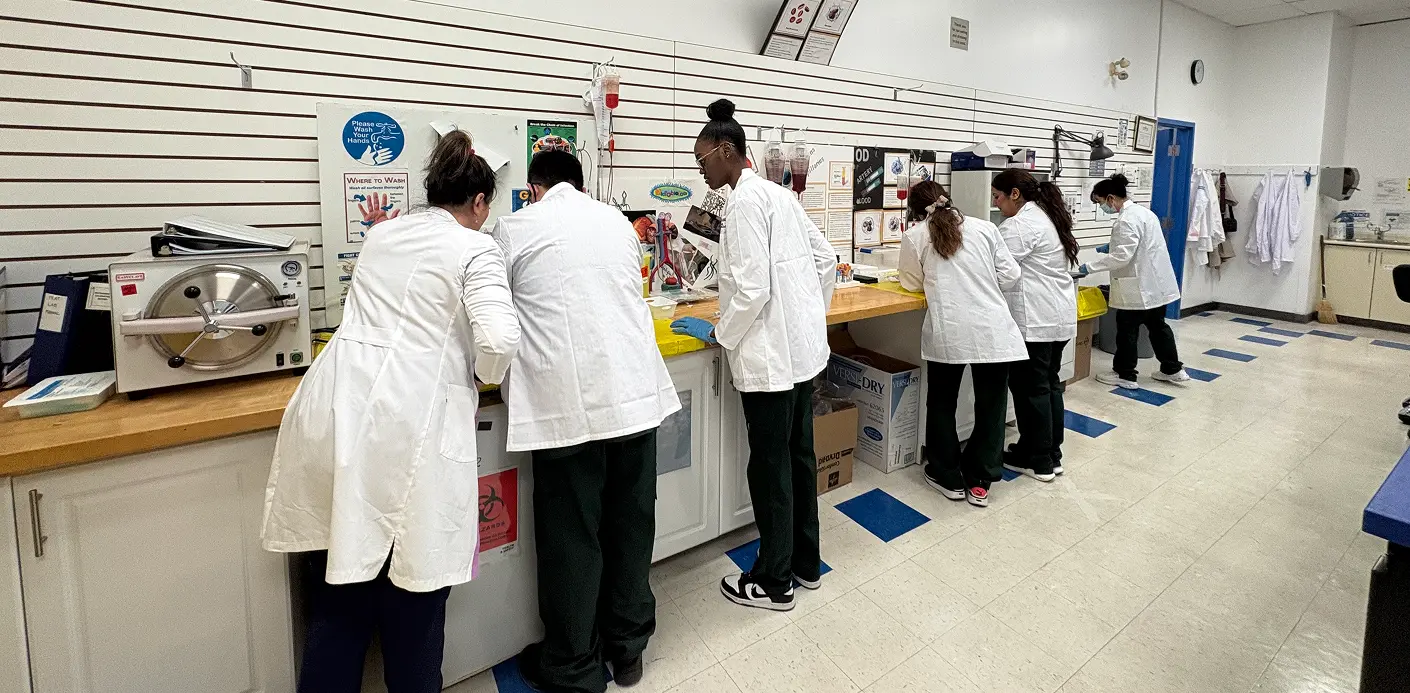
What Does a Medical Laboratory Assistant/Technician Do?
A Medical Laboratory Assistant/Technician collects, processes, and prepares patient samples, such as blood and other specimens, so they are ready for laboratory testing. Doctors rely on lab results to diagnose and treat patients, and those results depend on collecting, labeling, and handling samples correctly.
More Than Drawing Blood
Many people picture this job as taking blood from patients all day. Although collecting samples is part of the work, and you will learn to do it during the program, the role also includes working away from patients and inside the laboratory.
Here’s what the work involves day to day:
- Collect blood and other samples from patients
- Log patient samples and prepare them for testing
- Set up medical laboratory equipment
- Conduct routine laboratory tests and sample analyses
- Perform quality assurance of testing techniques
- Clean and maintain medical laboratory and medical laboratory equipment
Where the Work Happens
About 13,200 people work in this occupation in Ontario. Most work in one of two settings:
- 51 percent work in ambulatory health care, such as clinics and community laboratories
- 38 percent work in hospitals
- 77 percent work full time
Source: Job Bank Canada, National Occupational Classification (NOC) 33101, Ontario.
Who Hires Medical Laboratory Assistants/Technicians
- Hospitals
- Medical clinics
- Private and community laboratories
- Specimen collection centers
- Research facilities
What the Job Pays
In Ontario, wages for this occupation range from $17.62 to $36.00 per hour, with a median of $26.25 per hour.
Source: Job Bank Canada, NOC 33101, Ontario, updated November 19, 2025.
The Employment Outlook
Job Bank rates the employment outlook for this occupation in Ontario as moderate (three out of five stars) for 2025 to 2027. The rating is the same in all 11 of Ontario’s economic regions.
41
Weeks
to a diploma
200
Hours
in a working lab
100 km
Maximum placement radius
from your campus
6
Campuses
across the GTA and beyond
Why Oxford College: Qualify Sooner, Pay Less, Train
in a Working Lab
How our Medical Laboratory Assistant/Technician diploma compares with other private programs
| OXFORD COLLEGE | PRIVATE CAREER COLLEGES | PUBLIC COLLEGES | |
| Program length | 41 weeks | 50 to 55 weeks | 3 semesters |
| Total cost | $17,455 | $18,245 to $20,100 | $5,719 |
| Clinical placement | 200 hours, in a working lab | Up to 150 hours, with half published, with half in simulation | 5 to 6 weeks |
| Campuses | 6 | 3 to 5 | 1 |
The Three Advantages We Have
A CLEAR 41-WEEK TIMELINE
Every week in training is a week before you can start working in the field. Oxford College’s program takes 41 weeks and 900 hours, from first class to diploma.
LESS TO PAY, AND NOTHING HIDDEN
Tuition is $11,995. We publish every fee and show you what you pay to Oxford College and what you pay to third parties.
INSIDE A WORKING LAB BEFORE YOU GRADUATE
Your program ends with six weeks of clinical placement in a working laboratory within 100km of your campus (near where you live)
Three Costs to Weigh Before You Choose
a Program
The price of a program is only part of what it costs you to qualify. While you train, you pay fees and
also lose the income you could be earning.
| Cost | What it means | Oxford College program |
| What you pay | Tuition and fees, which you may need to cover through savings, loans, or a payment plan | $11,995 for tuition, and a total cost of $17,455 |
| The income you go without | The earnings you give up while you are in training instead of working | 41 weeks, about 10 months, in training |
| Time until you can work in the field | How long before you finish and can begin applying for jobs in this occupation | About 10 months (41 weeks), from your first class to a diploma |
Our program takes 41 weeks and 900 hours. You know from day one how long you will be in training, and the full cost is published before you apply.
Paying for Your Program
You can use one or more of these funding options to cover your costs:
Finance
Advisory:
Guidance provided for different types of student funding.
Better Jobs
Ontario:
A provincial program that can help eligible people pay for training in a new career.
Oxford College payment plans:
Spread your program costs over a set payment schedule.
Our Financial Aid team can walk you through which options you may be eligible for.
Know Exactly What You Pay
Here are all the fees for the Medical Laboratory Assistant/Technician program.
| Fee | Amount |
| Paid to Oxford College: $14,250 | |
| Tuition | $11,995 |
| Book Fees Paid to Oxford College | $835 |
| Expendable Supplies | $950 |
| Uniform | $310 |
| Professional Fees Paid to College | $160 |
| Paid to Third Parties: $3,205 | |
| Book Costs | $1,935 |
| Professional Exam Fee | $1,270 |
| Total amount | $17,455 |
NOTE: These fees apply to 2026. We update our fees on August 1 each year.
Ways to Pay
You do not have to pay the full amount at once. Our payment plans let you spread your fees over a set payment schedule. Guidance provided for different types of student funding.
Not sure how you will pay? Book a call, and someone from our team will walk you through your financial options.
What You Will Learn
The Medical Laboratory Assistant/Technician program takes 41 weeks and 900 hours. You take your courses one at a time, in sequence, so each one builds on the last. You finish your theory and lab training before you begin your clinical placement in weeks 36 to 41.
| Mode of Delivery | Module Name | Hours | Weeks |
|---|---|---|---|
| Online | Essential Skills: Professionalism | 40 | 1 – 2 |
| Online | Infection Prevention and Control | 20 | 3 |
| Online | Medical Terminology | 80 | 4 – 7 |
| Online | Introduction to Anatomy and Physiology | 108 | 8 – 13 |
| Hybrid | First Aid and CPR | 12 | 13 |
| Hybrid | Introduction to Laboratory and Safety | 60 | 14 – 16 |
| Hybrid | Phlebotomy and Specimen Collection | 40 | 17 – 18 |
| Hybrid | Laboratory Skills Practice | 40 | 19 – 20 |
| Hybrid | Laboratory Skills II – P.O.C.T, ECGs C Holter Monitors | 20 | 21 |
| Hybrid | Introduction to Hematology and Transfusion | 60 | 22 – 24 |
| Hybrid | Clinical Microbiology | 60 | 25 – 27 |
| Hybrid | Introduction to Clinical Chemistry | 60 | 28 – 30 |
| Hybrid | Introduction to Histology and Cytology | 60 | 31 – 33 |
| Hybrid | Final Review | 36 | 34 – 35 |
| Online | Final Exam | 4 | 35 |
| In-person | Clinical Placement | 200 | 36 – 41 |
| Total | 900 | 41 | |
Skills and Knowledge You Will Build
- How the human body is structured and how it works
- Medical terminology used in laboratories and health care settings
- Professional and ethical conduct, and the laws that apply to health care work
- Laboratory safety and infection prevention and control
- Blood collection and specimen handling
- Blood, blood disorders and transfusion science
- Electrocardiography (ECG), the recording of the heart’s electrical activity
- Clinical chemistry and the chemical processes in the human body
- Analysis of urine and other body fluids
- Microscopic examination of tissues and cells
- Practical math for accurate laboratory work
- Communication skills, first aid and cardiopulmonary resuscitation (CPR)
Meet Your Program Coordinator and Instructors
Learn from the people who lead Oxford College’s Medical Laboratory Assistant/Technician program.

Nabil Issa is an experienced medical laboratory educator with a strong background in healthcare and medical laboratory science. He holds a medical degree from Damascus University and a Canadian diploma in Medical Laboratory Technician training. With extensive experience teaching Medical Laboratory Assistant and Technician students, he combines theoretical knowledge with hands-on training in phlebotomy, specimen processing, laboratory procedures, and ECG. Nabil is passionate about helping students develop the practical skills, confidence, and knowledge they need to succeed in their future healthcare careers.
Nabil Issa
Program Coordinator
Campus
What Our Graduates Say
Graduates of Oxford College’s Medical Laboratory Assistant/Technician program share what
the program was like and what it prepared them for.
“My experience at Oxford College was a wonderful step toward achieving my career goals in healthcare. The Medical Laboratory Assistant/Technician (MLAT) program helped me develop valuable theoretical knowledge and practical skills. I am proud to have successfully passed my MLPAO examination and received my certificate. I am grateful to my instructors and the Oxford College team for their guidance and support throughout my journey. I would highly recommend Oxford College to anyone who is looking to build a career in healthcare.”
Batool Iftikhar
“Completing the MLAT program at Oxford College provided me with the essential practical skills and confidence needed to transition seamlessly into the healthcare field. The dedicated instruction and hands-on laboratory training prepared me directly for my clinical placement and current position as a Medical Laboratory Technician. I am grateful for the strong foundation Oxford College built for my career and highly recommend this program to aspiring healthcare professionals.”
Sayed Amin Haqbeen
“My time in the MLAT program at Oxford College was truly transformative. I am especially grateful to Dr. Erum Rehan, whose clear teaching, patience, and genuine care for her students made even the most challenging topics easy to understand. The entire faculty and staff were supportive, professional, and always willing to go the extra mile to help us succeed. The hands-on training and skills I gained gave me the confidence to step into the lab and grow in my professional journey.“
Promila Rani

“Choosing Oxford College for my MLAT training was a wonderful experience, especially as an adult learner. The hands-on training in phlebotomy gave me the exact skills and clinical confidence I use daily, and instructor Sukhpreet was incredibly supportive throughout the process. Beyond the excellent education, I truly enjoyed collaborating with my classmates and made wonderful, lifelong friends along the way. I highly recommend this program to anyone looking to a new career in healthcare.“
Mubashra Tariq
Certifications You Can Get After You Graduate
The program covers the competencies set by both of the bodies that certify medical laboratory assistants in Ontario. When you graduate, you are eligible to write both certification exams.
The Two Certification Bodies
| Canadian Society for Medical Laboratory Science (CSMLS) | Medical Laboratory Professionals’ Association of Ontario (MLPAO) | |
| Level | National | Provincial |
| What it grants | The Certified Medical Laboratory Assistant (MLA) designation | Medical Laboratory Assistant/Technician (MLA/T) certification |
| Required? | Voluntary | Voluntary |
| Exam format | Four sittings a year | Online |
| 2026-27 exam dates | October 26 to 30, 2026 | November 12, 2026 |
| February 22 to 26, 2027 | March 26, 2027 | |
| June 21 to 26, 2027 | June 17, 2027 | |
| October 25 to 29, 2027 | September 10, 2027 | |
| November 19, 2027 |
Registration periods for each exam date are listed on the CSMLS and MLPAO websites.
How This Program Is Accredited
Our Medical Laboratory Assistant/Technician program is Accredited with Condition by EQual Accreditation, a program of Accreditation Canada, at our Barrie, Mississauga, Peterborough, Scarborough and Toronto campuses, and holds Admitted status at Burlington while its accreditation is underway. You can find this program on Accreditation Canada’s list of educational programs.
Act disclosure:
Registered as a career college under the Ontario Career Colleges Act, 2005.
Intakes and Program Schedule
Multiple intakes every year
How the Program Is Delivered
The program is delivered in a hybrid format approved by the Ontario Ministry of Colleges and Universities (MCU). Theory is taught online, in real time, through Zoom and Canvas. Laboratory practice is taught in person on campus. All assessments, including tests and exams, are completed in person on campus.
WEEK 1-13
Online
Lectures are held online at scheduled times. You attend in real time through Zoom and Canvas.
WEEK 14 to 35
Hybrid
Theory continues online. Labs are held in person on campus.
WEEK 36 to 41
In person
Six-week clinical placement in a working laboratory within 100km of your campus.
Complete all assessments throughout the program in person on campus.
Morning and evening cohorts run at some campuses, subject to availability. Ask an Education Consultant which options are offered at your campus and intake.
Questions to Ask Before You Apply
These are the questions our Education Consultants hear most often.
1: Why do private colleges cost more than public colleges?
Public college programs often have lower tuition. When you compare programs, look at more than tuition alone.
- Total cost to qualify: Our program costs $17,455 in total for 2026, including tuition, books, supplies, uniform, and certification exam fees. Every fee is published, so you know the full amount before you apply.
- Time to qualify: Our program takes 41 weeks, about 10 months. The less time you spend in training, the sooner you can start looking for work in the field.
- Entry requirements: To be admitted, you need an Ontario Secondary School Diploma (OSSD) or equivalent, or mature student status with a qualifying score on the Wonderlic SLE-17 (score of 17 or higher).
2: How can I pay for the program?
The total cost for 2026 is $17,455.
Out of that, $14,250 goes to Oxford College, and $3,205 goes to third parties. The fee table above includes the full breakdown.
You may be able to use one or more of these options:
- Ontario Student Assistance Program (OSAP)
- Better Jobs Ontario
- Oxford College payment plans, which spread your fees over a set schedule of payments
3: Will the science and medical English be difficult?
This is a demanding program, and it is important to know what it involves before you apply.
- Heavy theory load: You will study anatomy and physiology, hematology, clinical chemistry, microbiology, and histology, along with medical terminology used throughout.
- Blood collection from week 17: You begin drawing blood from week 17 of the program
- Strict attendance: Attendance is required throughout, and a leave of absence is not available. You must attend all six weeks of clinical placement.
- In-person assessments: All tests and exams are completed in person on campus.
The program includes courses in medical terminology, communication, and medical terminology and communication. If you have questions about whether the program is right for you, an Education Consultant can talk it through with you.
4: Can international students apply to the Medical Laboratory Assistant/Technician program?
No. The Medical Laboratory Assistant/Technician program at Oxford College is open to Canadian citizens, permanent residents, and protected persons or Convention refugees. Oxford College cannot enroll international students or other visa holders in this program.
5: Does accredited with condition mean you will get accredited or not?
Our Medical Laboratory Assistant/Technician program is Accredited with Condition by EQual Accreditation, a program of Accreditation Canada, at our Barrie, Mississauga, Peterborough, Scarborough and Toronto campuses, and holds Admitted status at Burlington while its accreditation is underway. At these five campuses, the program is accredited. Accredited with Condition is an accreditation status, not a step before accreditation. Accreditation Canada uses it when a program partially meets its accreditation standards. What happens next: to keep its accreditation, the program must make specific changes and show Accreditation Canada that it meets the standards, within a set period. At Burlington, the program holds Admitted status, which means the accreditation process has started but is not yet complete. What this means for you: graduates from all six campuses, including Burlington, are eligible to write both the CSMLS and MLPAO certification exams.
Ready to Qualify in 41 Weeks? Start Here
Labs and all assessments are completed in person on campus. Attendance is strict, and a leave of absence is not available. You will draw blood from week 17.
PLEASE NOTE:
NEW CLASSES START IN JANUARY, MAY AND SEPTEMBER.
Get the program details, the full cost, and your next start date.